Does Prompt Engineering Actually Produce Better Responses?
A small experiment

I’m sure you’ve heard this term before: “Prompt Engineering.” The first time you heard this term, you probably had no idea what it was, or why it matters when prompting AI for your specific needs. I think it’s important to give a definition. According to Amazon Web Services (AWS), prompt engineering is a process where you guide artificial intelligence solutions to generate desired outputs.
Prompt engineering may sound difficult, when in reality it’s nothing more than giving AI a little more information about your project, task, or context about you as a person, to receive a better output. As someone who has prompted AI with and without prompt engineering, I can attest that spending a little extra time crafting a thoughtful prompt is absolutely worth it.
In this post, I will walk you through a little simulation I did with Gemini to prove how much of a difference it makes.
Background Info
For this experiment, I used two different prompts and tested them on Gemini 3.5 Flash (thinking level extended) to see what kind of difference a simple prompting change would make. I made sure to give Gemini the same task, just using different levels of context. In this case, I asked Gemini to give me the best 10 parks for my boyfriend and I to visit in Atlanta.
First, I just used a basic one sentence prompt. Second, using prompt engineering, I asked Gemini with the CRISPER framework. The CRISPER framework stands for: Context, Role, Instruction, Steps, Parameters, Examples, and Return output. It is a method used by many to get the most accurate response out of AI. Instead of having to re-prompt AI multiple times, your task is now at least 90% done simply by using a more detailed prompt.
Here are the two prompts I used:
Basic: “Hey Gemini, suggest 10 parks for my boyfriend and I to visit in Atlanta.”
Prompt engineered (Using the CRISPER framework):
Context: My boyfriend and I have been together for five years and love big parks where we can walk for a while. We also like parks with shade and lots of trees.
Role: You have lived in Atlanta for decades and know every park.
Instruction: I need you to find the best 10 parks for my boyfriend and I using our preferences in the context and parameters. Underneath the park, tell me exactly why it’s a good fit.
Steps:
1) Read the context and instruction and find the best parks for us
2) List the parks out by desirability and rank based on which to try first
3) Then provide a brief explanation under each detailing why it would be a good fit.
Parameters: Make sure these parks are in Atlanta or metro Atlanta.
Examples: **this section may not be the most relevant for this specific prompt, but in future prompts you would provide a specific example of an output you would like. This would allow you to give the best example of tone and how you would like it to respond**
Return output: Here is an example of what the output should look like
1. (Park Name) and photo
(explanation)
Results
Results using basic prompt:
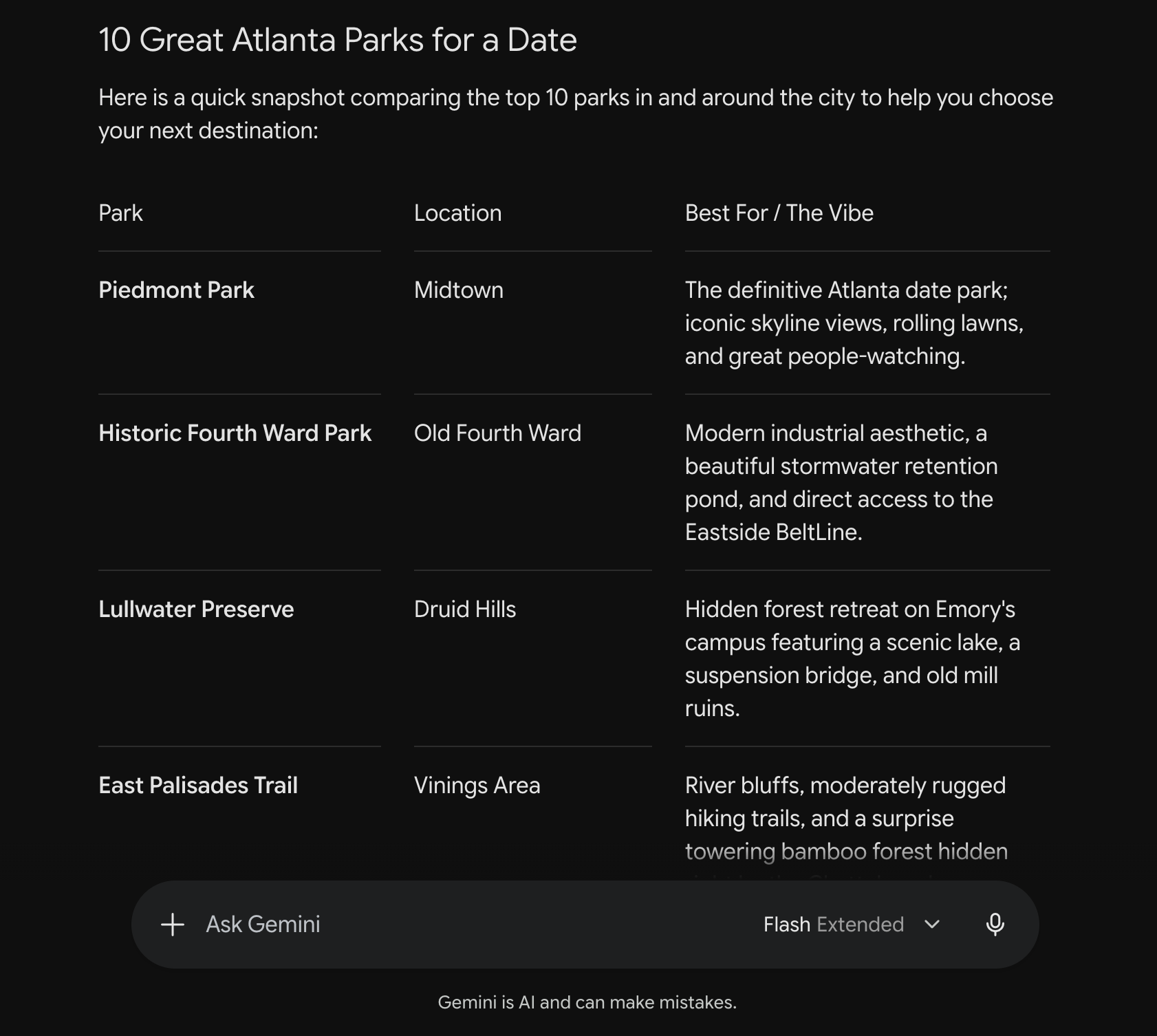
As you can see from the screenshot, Gemini did what I told it to do. However, because my prompt had no specificity, it ended up returning random parks (that are great) but don’t exactly meet my criteria. It also doesn’t include photos of the parks.
Prompt engineered (CRISPER framework):
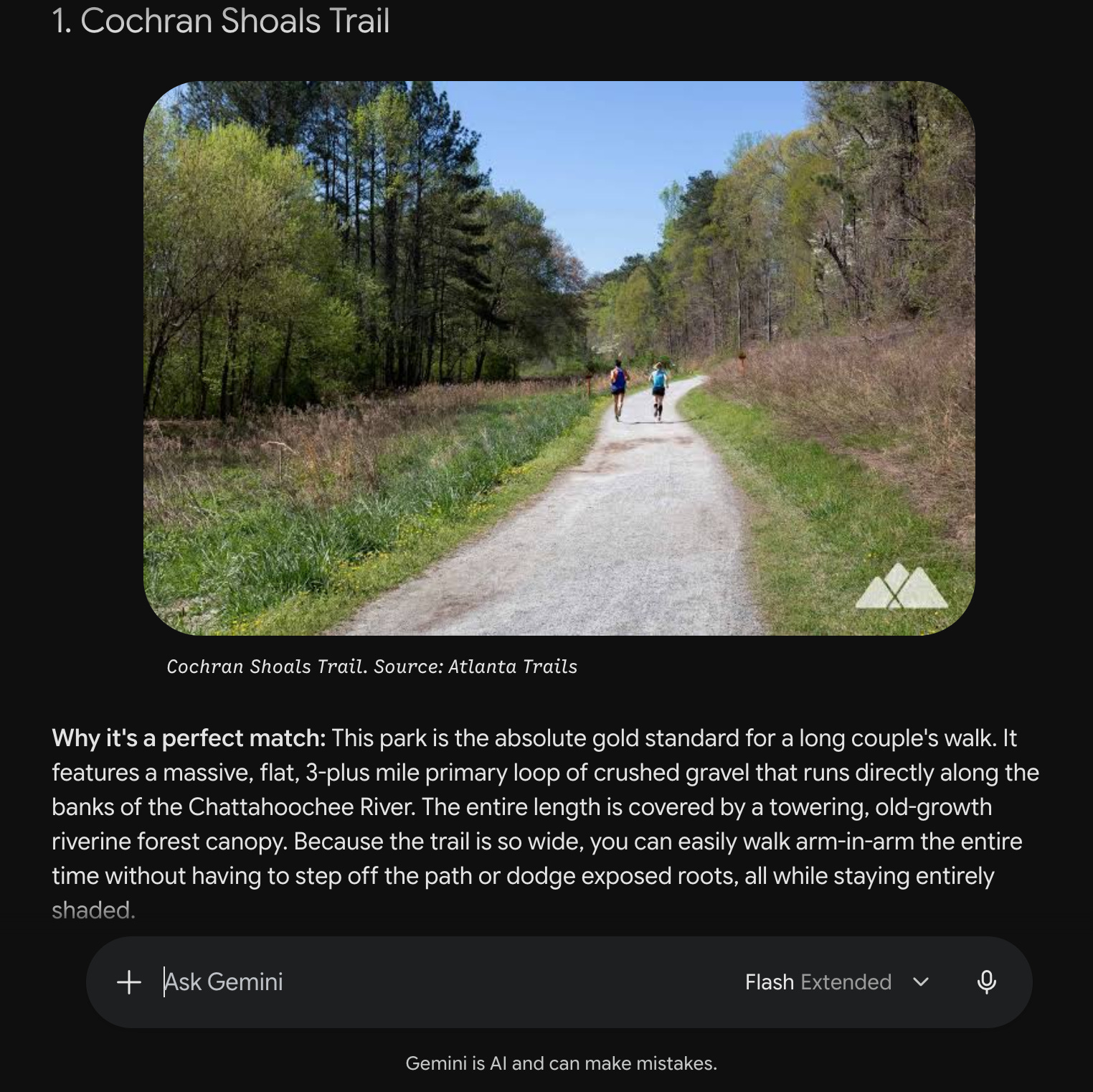
And this is just one example of the 10 recommended parks it gave me.
As you can see, it responds exactly how I prompted it to: it provided a photo, the name of the park, and gave a brief explanation as to why it’s a perfect match.
All I had to do was spend an extra 2 minutes writing a more specific prompt.
Key Takeaway
I hope this little experiment helped you to understand why it’s important to use prompt engineering when communicating with AI for tasks.
When you provide AI with a basic prompt, it gives you a basic response that’s sufficient if you have no specific criteria or specifications. However, if you have criteria that need to be met (such as trees for shade), or simply want to give the AI more context for a better response, prompt engineering is something that is important to get used to.
CRISPER is not the only framework you could use. There are many others, and you should do some digging to find out which one works best for you.
In a rapidly changing world where people and companies are using AI as the norm, it’s important to stay up to date with the latest updates and equip yourself with a baseline level of knowledge!