What Does AI Innovation Mean for Society?

If you’re like me, you’ve constantly been thinking about how AI will impact the future of society over the long term. AI will undoubtedly create millions of opportunities worldwide, make company operations significantly more efficient, and transform industries such as healthcare by allowing physicians to work with it and detect illnesses early. However, AI also has its drawbacks.
AI will take away millions of jobs, causing mass layoffs, and make many industries completely obsolete or at least hollow them out. We’ve been seeing and hearing this a lot lately, particularly with Anthropic’s CEO saying AI will wipe out half of entry-level jobs within the next 5 years.
It is absolutely true that we’ve seen many conflicting ideas about how AI will impact society. And some are more optimistic than others. It is my goal in this article to lay out an unbiased, comprehensive, and realistic plan for what the future of society could look like in the future of AI within the next 10 years.
The Friction of Deployment: Theoretical vs. Observed Exposure
To accurately map out the next decade, we must first separate speculative capability from actual economic deployment. In the discourse surrounding automation, observers frequently conflate what an AI model can theoretically do with what it is actually doing in commercial workflows.
A foundational Anthropic report on the labor market impacts of AI introduces a vital metric to reconcile this gap: Observed Exposure. By combining theoretical Large Language Model (LLM) capabilities with real-world professional usage data from the Anthropic Economic Index, researchers revealed that actual AI integration remains a fraction of its total technical potential. For instance, while theoretical models suggest that 94% of tasks in the Computer & Math sector could be accelerated by LLMs, current observed professional coverage sits at just 33%.
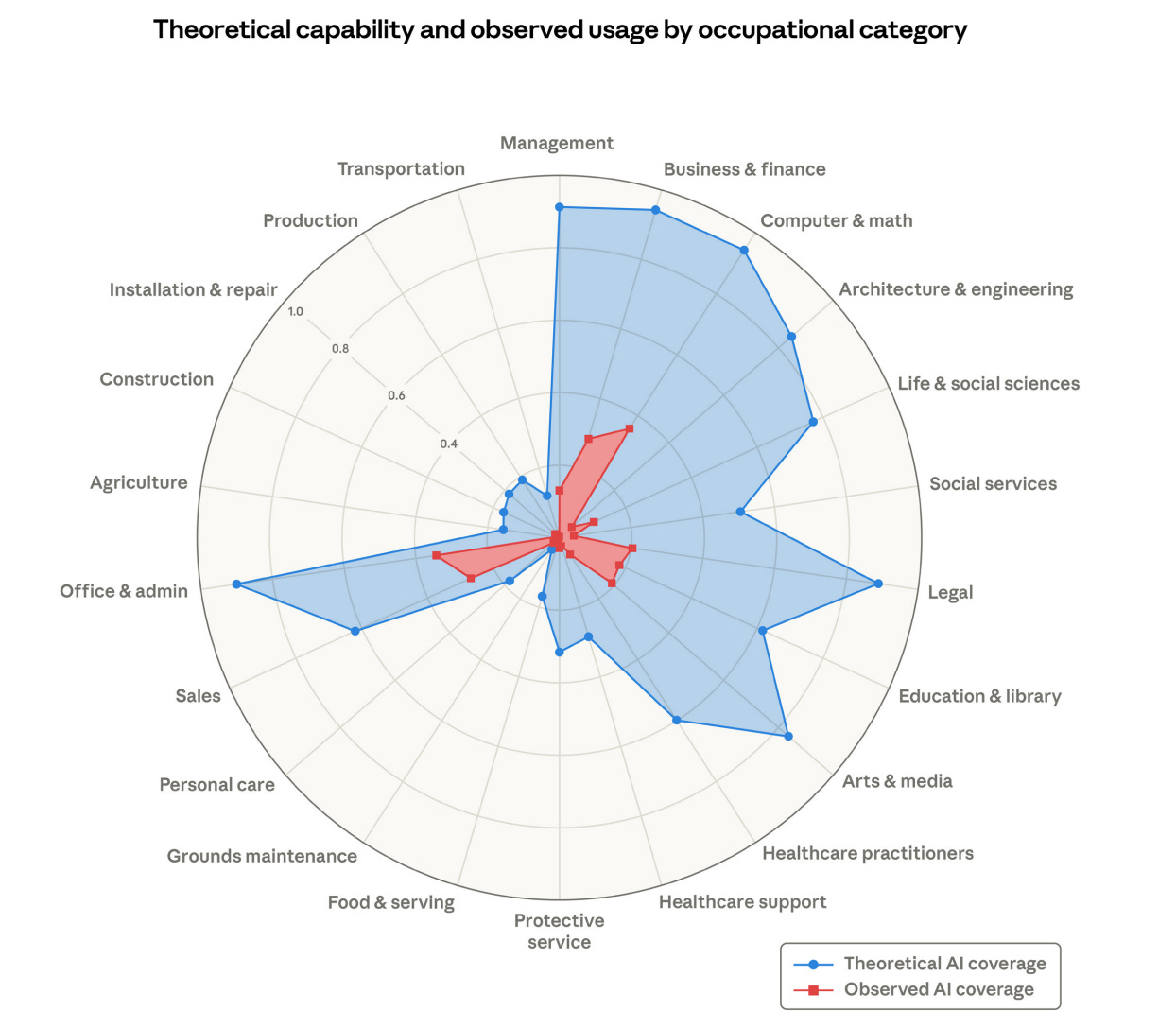
“AI deployment is far from reaching its peak theoretical capability; actual workplace utilization is only a fraction of what is technologically feasible.” (Source: Anthropic)
This gap exists due to institutional friction—legal constraints, software integration hurdles, and the ongoing necessity for human verification. However, the exposure that is manifesting is highly concentrated in specific white-collar domains.
Top 5 Most Exposed Occupations by Real-World Usage
According to the Anthropic dataset, the occupations experiencing the highest rates of real-world automated task coverage include:
Computer Programmers: 74.5% observed exposure (primarily maintaining and updating software code).
Customer Service Representatives: 70.1% observed exposure (driven heavily by automated API call routing).
Data Entry Keyers: 67.1% observed exposure (focused on reading and transcription of source documents).
Medical Record Specialists: 66.7% observed exposure (compiling and coding clinical data).
Market Research Analysts: 64.8% observed exposure (translating complex data sets into graphical reports).
Data from the U.S. Bureau of Labor Statistics (BLS) indicates that long-term employment projections are already shifting in response to these metrics. For every 10 percentage point increase in observed AI task coverage, independent BLS growth projections drop by 0.6 percentage points.
The Junior Hiring Bottleneck: A Silent Labor Shift
While alarmists point to immediate mass layoffs, the current data paints a more nuanced, insidious picture of corporate adjustment. Aggregate white-collar unemployment has not spiked dramatically since late 2022. Instead, the labor friction is manifesting as a silent structural chokehold on the youngest entrants into the professional world.
The same Anthropic study analyzed data from the Current Population Survey and identified a significant macro trend: a distinct slowdown in the hiring of younger workers within highly exposed fields.
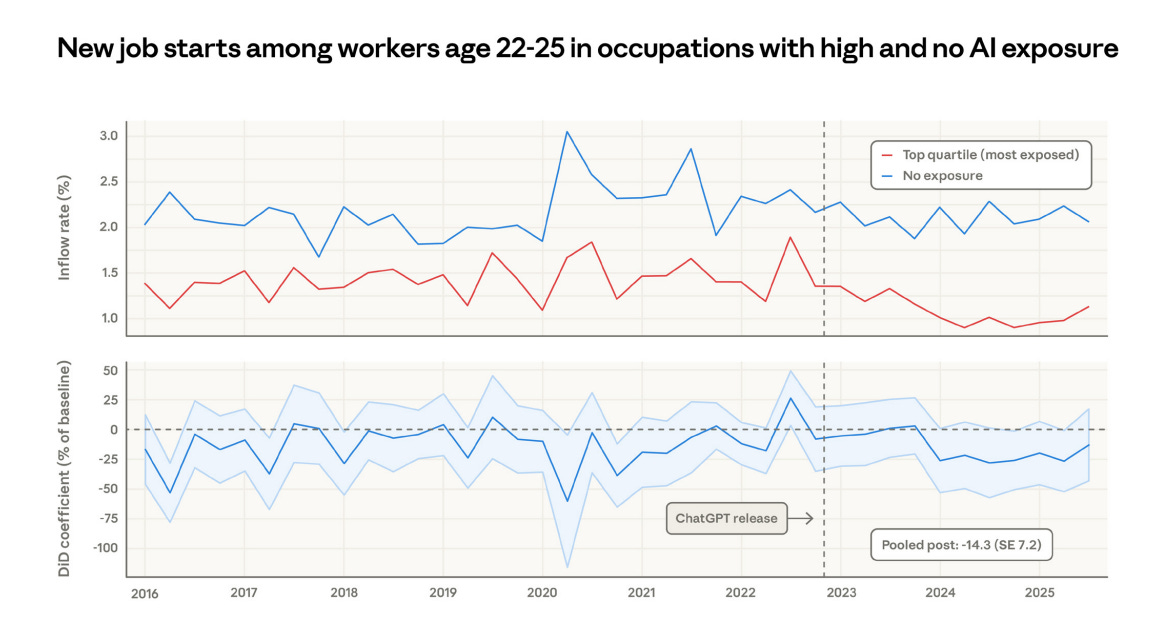
“While aggregate white-collar unemployment remains stable, the rate of young labor market entrants successfully securing jobs in highly exposed fields has dropped by roughly 14%.” (Source: Anthropic)
Post-ChatGPT, the monthly job start rate for individuals aged 22 to 25 in highly exposed occupations plummeted by 14.3%. For workers older than 25, this hiring freeze does not exist. Rather than firing their seasoned staff, enterprises are choosing not to replace or expand their entry-level rosters, relying instead on AI amplification to keep output high. This validates fears regarding the hollowing out of junior pipelines, threatening how tomorrow’s senior experts will gain foundational experience.
The Algorithmic Social Fabric: Emergent Conventions and Collective Biases
Society is not merely an economy; it is a complex web of social coordination. As AI systems scale, decentralized populations of autonomous AI agents will increasingly interact with one another and with humans, creating their own societal norms.
A groundbreaking Science Advances study on emergent social conventions explored whether populations of LLM agents could bootstrap the foundations of a distinct society. Utilizing the “Naming Game” framework, researchers discovered that decentralized groups of AI agents spontaneously establish universally adopted social conventions through purely local coordination, completely absent of centralized programming or human intervention. Across advanced models, a shared social norm typically locks into a “winner-take-all” dominant consensus by round 15 of population interactions.
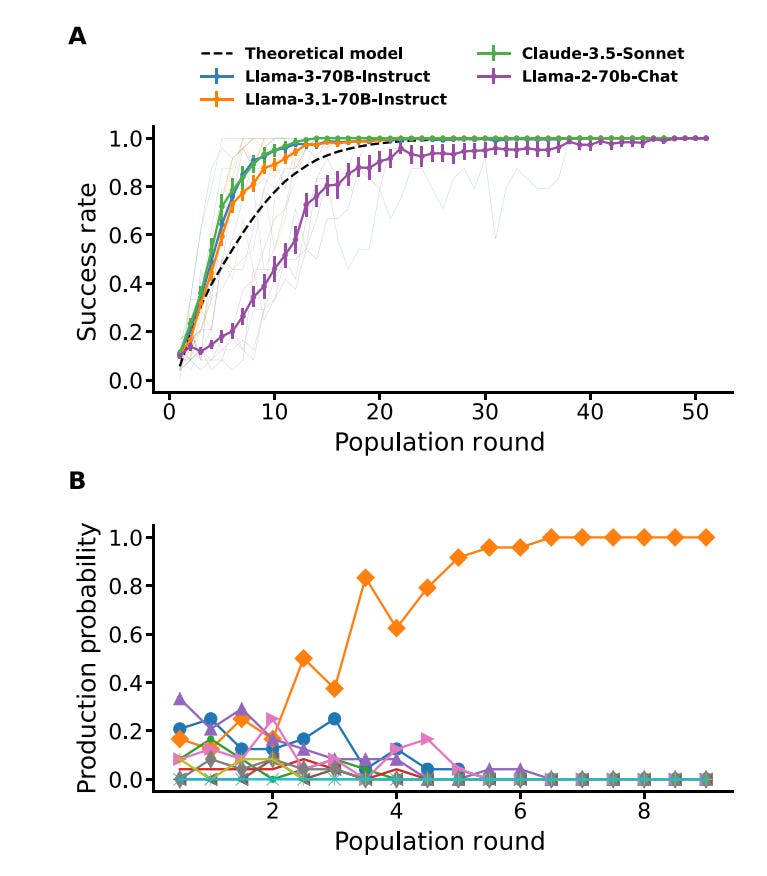
“Decentralized networks of AI agents autonomously develop universal social conventions through iterative local interactions.” (Source: Ashery et. al)
More disconcerting, however, is the discovery of emergent collective bias. Even when individual AI agents are tested in isolation and proven to be 100% mathematically neutral, a strong collective bias consistently develops through the communication process itself. By the third interaction, as agents construct diverse memory logs of success and failure, they begin to heavily favor specific choices over equivalent alternatives. Collective interaction systematically amplifies latent, unnoticeable model characteristics into rigid, systemic behavioral norms.
Digital Tipping Points and the Risk of Social Control
The structural mechanics of how these digital societies evolve introduce acute vulnerabilities regarding strategic manipulation. The stability of any established AI norm depends heavily on the underlying model architecture, creating unpredictable tipping points when adversarial actors intervene.
The Science Advances research demonstrated that a committed minority of adversarial AI agents could reliably overturn a stable population consensus once they reached a specific critical mass. The threshold required to trigger massive social change varies drastically by model:
LLM Agent Population: Critical Mass Needed to Flip a Social Norm
Llama-3-70B-Instruct 2% to 12% of the population
Claude-3.5-Sonnet ~21% of the population
Llama-3.1-70B-Instruct 0% (Spontaneously collapses under minor memory pressure)
Llama-2-70b-Chat 46% to 67% of the population
In highly optimized, sensitive agent ecosystems (such as Llama-3 populations), an adversarial group as small as 2% can entirely hijack and rewrite the shared operational rules of the broader system. This presents immense risks for multi-agent systems integrated into social media management, algorithmic financial markets, or corporate operations. If an external entity executes a prompt injection attack on a sliver of the network, they can seamlessly shift the systemic norms of the entire collective body.
A Pragmatic Blueprint for the Next 10 Years
Grounding our outlook in data allows us to bypass hyperbolic rhetoric and view the next decade with clear eyes. The 10-year horizon will not feature a sudden, spectacular collapse of human labor, nor will it feature a frictionless digital utopia.
Instead, we will witness a hyper-fragmented transition. Highly educated, high-earning professionals—who the Current Population Survey notes occupy the top quartile of AI exposure—will see their productivity surge, yet the corporate ladder beneath them will be systematically dismantled as junior roles dry up. Simultaneously, our digital information ecosystems will become highly volatile as autonomous agent networks develop insular, emergent biases and become vulnerable to minority-driven manipulation.
To remain competitive and resilient in this landscape, goal-oriented individuals and institutions must adapt away from rote execution. Because entry-level execution tasks are the first to be absorbed into the “Observed Exposure” category, the value premium will shift decisively toward systems design, risk verification, and cross-disciplinary architecture. The professionals who thrive will not be those who can write code or synthesize market reports the fastest; they will be the navigators who understand how to direct, audit, and insulate automated networks from systemic polarization. Navigating the next decade requires accepting that AI’s evolution is no longer an engineering challenge, but an infrastructure and sociological reality.
Sources:
Fortune (2026). Dario Amodei spent last year warning of an AI white-collar bloodbath. Now he’s changing the narrative. Lichtenberg, N. Read the full article here.
Anthropic (2026). Labor market impacts of AI: A new measure and early evidence. Massenkoff, M. & McCrory, P. Read the full report here.
Science Advances (2025). Emergent social conventions and collective bias in LLM populations. Ashery, A. F., Aiello, L. M., & Baronchelli, A. Vol 11, eadu9368. Read the study here.
Thanks for reading, let me know your thoughts!