What Is Value?
What does it mean to have and provide value?

What Is Value?
This is a question I’ve been thinking a lot about over the last few weeks. For people like me who have recently graduated from college and are mindful of spending, knowing the value of a product in comparison to others is of the utmost priority. Most consumers want to know that what they are buying is going to provide them with an equal amount of value as the amount of money they put into the item.
When you walk into a grocery store and scan the shelves of the canned food aisle, there are tens of choices of salsas, beans, and tortillas. Some brands are more expensive, and some are less expensive. Some are name brands, and others are generic store brands. The options you choose are a direct statement of what you value.
For example, if you choose to buy the name brand over the store brand, you may value buying from local/small businesses depending on the product. However, if you buy from store brands, this says you may be more cost conscious.

The Digital Supermarket: Shifting Paradigms of Utility
But what happens when the shelf isn’t filled with tangible goods like salsa or tortillas, but with complex digital architectures? In the modern market, the concept of consumer value has shifted from physical utility to digital enablement. In the broader marketplace, nobody ever explicitly defines what value is; instead, we as consumers are constantly making unconscious decisions about what we deem valuable. This hidden calculus is vividly observable in the rapid audience segmentation occurring within consumer Artificial Intelligence—specifically between OpenAI’s ChatGPT and Anthropic’s Claude.
Where we spend our time and digital dollars reveals a profound divergence in what different consumer brackets value. While one platform has captured the cultural zeitgeist as a democratic, generalist assistant, the other has carved out a distinct domain as a high-leverage professional engine.
ChatGPT and the Value of Broad Democratization
To understand what drives the modern consumer, one must look at the sheer scale of OpenAI’s ChatGPT. According to data published by OpenAI’s Economic Research team and Harvard economist David Deming, ChatGPT has scaled to a staggering 700 million weekly active users. What these hundreds of millions of consumers deem valuable isn’t necessarily niche technical specialization, but rather broad accessibility and conversational advisory power.
The data demonstrates that ChatGPT’s value proposition lies in its radical democratization. By mid-2025, the platform’s early adoption gender gap narrowed completely: users with typically feminine names grew from 37% in January 2024 to 52% in July 2025, mirroring the general adult population. Furthermore, its value as an economic equalizer is global. By May 2025, ChatGPT’s adoption growth rates in the lowest-income countries were over four times higher than those in the highest-income nations.
When we analyze why these consumers utilize the platform, their unconscious designations of value become clear:
The Everyday Advisor: Approximately 49% of ChatGPT interactions fall under the category of “Asking,” proving that consumers value the model highly as an information source and advisor rather than just a mechanical task-completer.
The Lifestyle Split: A massive 70% of consumer usage is entirely non-work related, while only 30% pertains to professional tasks.
Practical Utility: Three-quarters of all conversations center on everyday practical guidance, information seeking, and standard writing tasks.
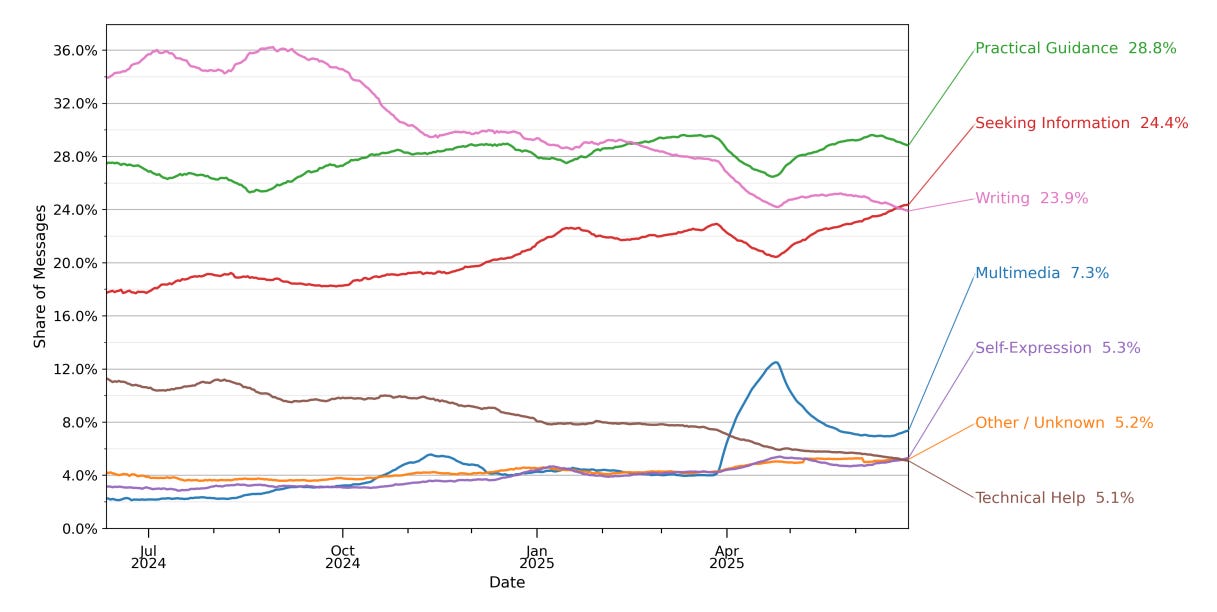
For the general consumer, and particularly younger generations navigating daily life, ChatGPT’s value is found in its multi-purpose, democratic availability. It is the generic, highly reliable utility that balances the ledger of daily life.
Claude and the Premium on Professional Leverage
Conversely, Anthropic’s Claude highlights an entirely different consumer psychology: value defined by professional survival, specialized output, and career leverage. In a sweeping survey of 81,000 Claude users published in April 2026, Anthropic revealed an audience deeply embedded in high-exposure, white-collar environments.
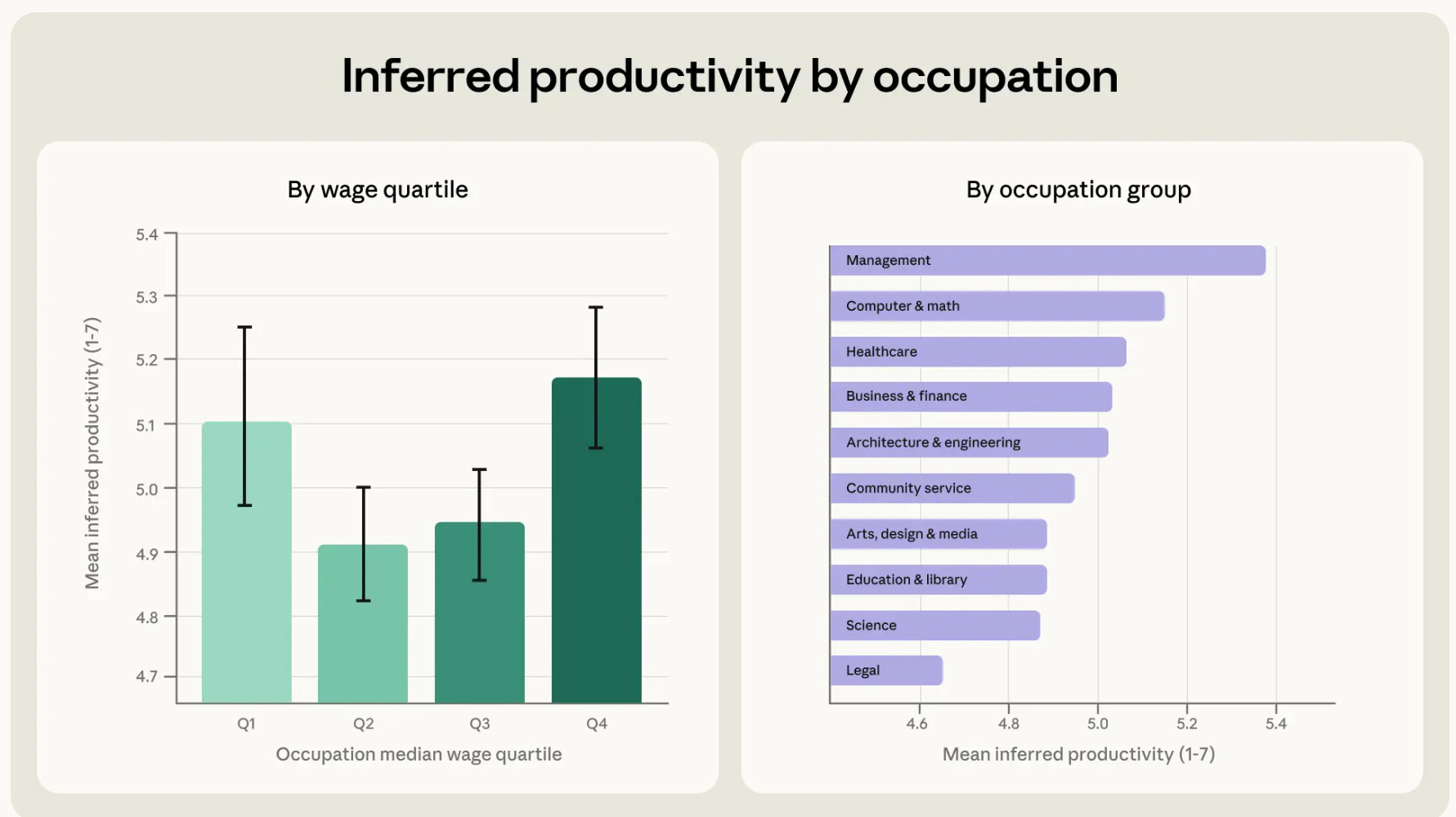
Claude users do not primarily view AI as a casual advisor for non-work exploration. Instead, they quantify its value through strict productivity metrics. Respondents reported a mean productivity rating of 5.1 out of 7, indicating they feel “substantially more productive” when using the tool.
This professional consumer segment designates value based on two distinct operational dimensions:
Scope Expansion (48% of users): Consumers value the tool because it unlocks entirely new capabilities, allowing non-technical individuals to perform advanced tasks like full-stack development.
Speed Acceleration (40% of users): Users value the drastic compression of labor time, such as turning a two-hour corporate financing task into a 15-minute routine.
The data shows that the highest productivity gains are heavily concentrated among high-paying professions like management and computer-related fields. However, even lower-wage workers who choose Claude are doing so with an entrepreneurial focus—such as delivery drivers and landscapers utilizing the model to build e-commerce side businesses or coding applications. For this audience, value is an investment in economic upward mobility.
The “Value Tax”: Economic Anxiety and the Consumer Catch-22
An investigative look into consumer habits reveals that we do not always designate value out of pure optimization; sometimes, we buy out of defensive necessity. This is the darker, psychological undercurrent of the AI marketplace.
Anthropic’s research highlights that one-fifth (20%) of active users express deep concern over economic displacement and job loss driven by the very technology they are using. This anxiety is heavily correlated with a metric called “observed exposure”: the percentage of a job’s daily tasks that the AI can successfully execute. Software engineers, web developers, and legal professionals are paying for and interacting with these tools precisely because they are aware of their displacement risk.
This existential calculus varies dramatically depending on the consumer’s career stage:
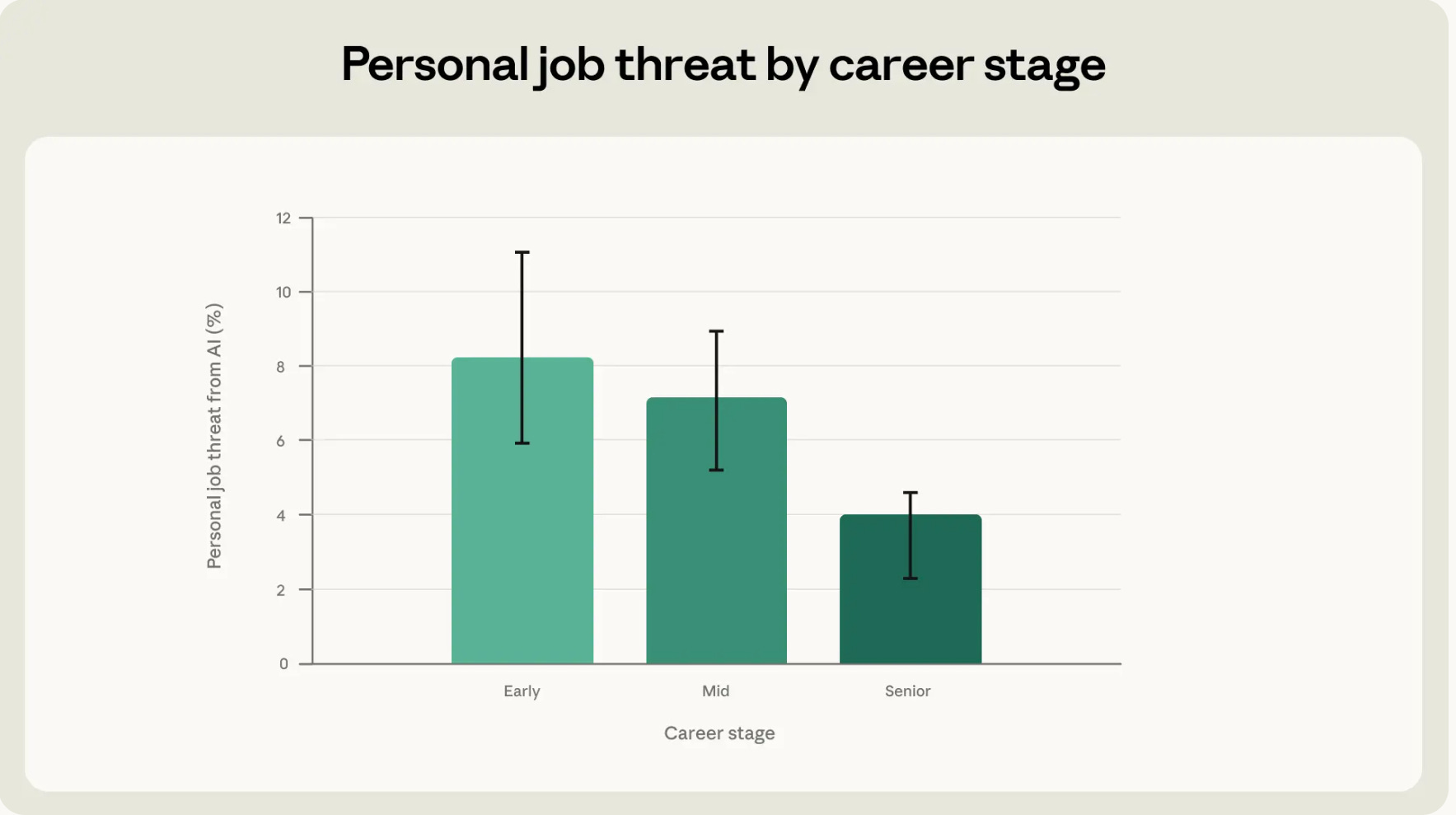
“Early-career respondents were much more likely to express concern about job displacement than senior workers.”
Only 60% of early-career workers reported that they personally benefited from these productivity gains, compared to 80% of senior executives and professionals. For a recent college graduate, the decision to adopt a high-tier professional tool like Claude is often an unconscious, defensive act. They are attempting to artificially inflate their operational “scope” to remain viable in a entry-level job market that is actively contracting.
This creates a striking paradox in consumer sentiment. Anthropic discovered a distinct U-shaped relationship between task speedup and job dread: those who experienced the absolute highest acceleration in their workflows were simultaneously the most terrified of their roles being automated away entirely. The core feature that gives the product its immense value (unprecedented speed) is the exact same attribute generating consumer anxiety.
What Our Choices Say About Us
Ultimately, our digital choices mirror the grocery store shelves far more than we realize. Deciding to spend twenty dollars a month on a premium platform like Claude or using the free tier of ChatGPT isn’t just a choice between software packages; it is a silent ballot on what we require to navigate our daily lives. The consumer who defaults to ChatGPT is buying into a collective, democratic infrastructure—a multi-purpose tool that smooths out life’s routine friction points and democratizes knowledge globally. Conversely, the professional pulling out their wallet for Claude is treating AI as an essential piece of career body armor. In both scenarios, the absolute definition of “value” remains unwritten, yet it is vividly expressed through our daily online behaviors.
This shifting paradigm signals a deeper truth about the modern consumer psyche: value is increasingly tied to existential positioning rather than simple utility. Whether driven by the optimistic pursuit of global democratization or the anxious, defensive need for white-collar survival, our interactions with these complex architectures reflect who we are and who we are afraid of becoming. The digital tools we choose to integrate into our daily routines don’t just solve immediate problems; they tell the definitive story of our ambitions, our economic constraints, and our personal value metrics in a rapidly accelerating world.